One identity primitive to fix multiple leaks in your supply chain.
Give every unit its own identity, using the label you already print. Then stop counterfeits, diversion, returns fraud and more with the same scan.
Counterfeits Are fake products infiltrating your supply chain, eroding trust and revenue?
ROI calculator
Size the problem for your brand. Move the sliders and the numbers update as you go.
What counterfeits cost you
Illustrative only. Your numbers depend on category, markets and channels.
Counterfeit sales = annual revenue × share ÷ (1 - share), valued at your price. At 10%, 1 in 10 units sold under your name is fake. Sales you can add = counterfeit sales × the share you recover.
What you lose to the gray market
Illustrative only. Your numbers depend on category, markets and channels.
Margin lost = revenue × share diverted × discount. What you can save = margin lost × the share you recapture.
Your ERP knows the SKU. It has no idea where each unit actually went.
Barcodes and batch codes identify a product line, not a product. When 100,000 units share one code, no one can prove which unit leaked, which one is fake, or which one should be recalled.
Two labels off the same press.
Two different identities.
Every printed label carries random paper fibers and ink bleed that no printer can control or repeat. Drag the slider to zoom in and see it.
Enroll once. Verify anywhere.
A camera on the packaging line reads each label.
An industrial camera and an edge processor create a fingerprint for every unit in about 100 ms, at up to 1,200 units per minute. Labels can also be enrolled before they are applied or at the label printer.
Each unit is tied to where it was sent.
At dispatch, fingerprints are linked to the distributor, date and invoice. Your ERP keeps working as it does today; Idanta adds the unit-level truth it was missing.
Anyone checks it with a smartphone.
Distributors, retailers, field teams and consumers point a phone camera at the label. The app matches the microstructure and returns the unit’s identity, batch and route.
Turn a suspicion into evidence.
A test buy from a marketplace scans back to the exact distributor and ship date. You can enforce contracts, stop shipments and take legal action with proof.
The full walkthroughOthers add something. Idanta reads what is already there.
QR codes, RFID, holograms
Idanta
Enroll a unit once. Use it six ways.
Anti-counterfeit
A copy of your label, however perfect, has different microstructure and fails the check.
Protect your brandAnti-diversion
Trace a gray market unit back to the distributor who leaked it, with the ship date.
How tracing worksReturns and warranty fraud
Distributors and consumers send back fakes for credit. Confirm each return is a unit you actually shipped, before you refund, credit or replace it.
Stop paying for fakesTargeted recall
Know which units went where, and group complaint units on a time axis for faster root cause work.
Recall preciselyInventory truth
Give distributors and retailers a scan that confirms what is physically on the shelf.
See by industryConnected packaging
Every consumer scan is first-party data: who bought, where and when, with no new packaging.
Engage buyersEnrolls at line speed. Verifies in the real world.
Proven in multiple pilots and commercial deployments.
Verifies in uncontrolled conditions, with the phones people already carry.
- Any lighting
- Handheld angles
- Scuffed and dirty labels
- Up to 30% of the read area damaged
- Ordinary 20 MP phones
Built for the quirks of your industry.
Every category leaks differently. Super stockists in India, MAP violations on US marketplaces, QR mandates in pharma. We start from how your product actually moves.
FMCG and household care
Counterfeits and diversion Pouches, tubs and tinsFood and dairy
Counterfeit food in trusted packs CartonboardPharmaceuticals
Counterfeits and QR mandates Printed cartonsTobacco
Illicit trade and tax loss Polymer labelsAgrochemicals
Fake inputs that hurt yields Labels on partsAuto parts and lubricants
Counterfeits through dealer channels Book coversPublishing and education
Gray market textbooks 9 industriesSee every industry
Including paints and consumer electronicsAll industriesThe latest from Idanta.
Meet Idanta AI at Pack Expo 2026 in Chicago
Every pack on the shelf looks the same. Under a microscope, no two labels are. If you work on packaging, brand protection or channel integrity, let’s find 30 minutes on the show floor.
View on LinkedIn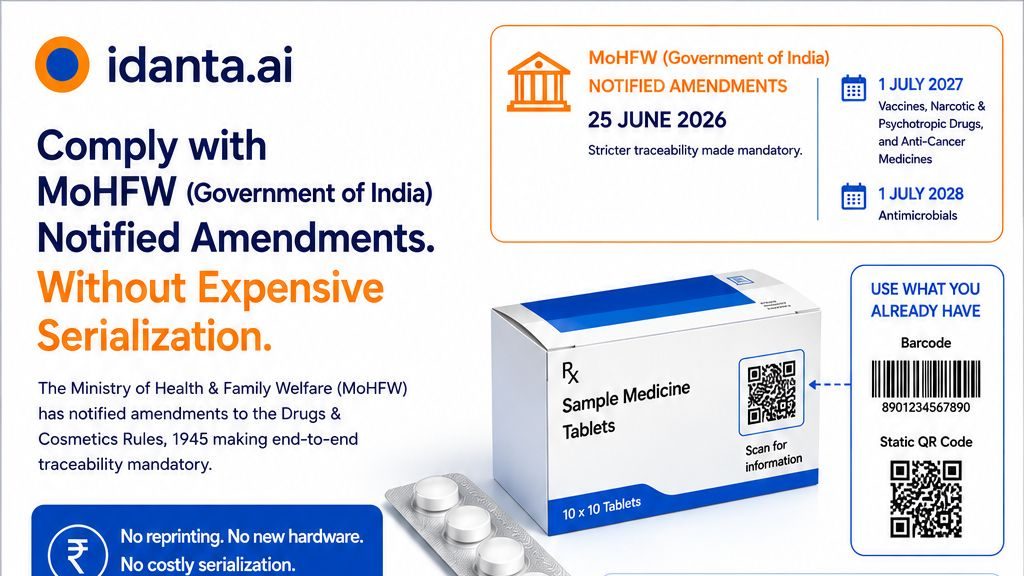
India’s new drug traceability rules, without expensive serialization
The Health Ministry’s June 2026 amendments make track and trace mandatory for vaccines, cancer and narcotic drugs from July 2027. Idanta works with the barcode or QR code you already print, so you keep your compliance workflow and close the cloning gap.
View on LinkedInBuilt by people who have lived the problem.
Four co-founders from the IITs and ISB with 85+ combined years across supply chain software, AI products, computer vision and enterprise sales.
Meet the founders Mahesh YellaiCEO
 Ravi UppalaCPO
 Dr. Mohan RavichandranCTO
 Yash MahendraCRO
Questions buyers ask
What does Idanta do?
Idanta gives every individual product unit its own digital identity. It reads the microscopic randomness already present in the product's existing label (paper fibers, ink bleed, surface texture at about 20 microns) and turns it into an unclonable fingerprint that anyone in the supply chain can verify with a smartphone.
Do we need to change our labels or packaging?
No. Idanta works on the labels and cartons you already print. There are no new tags, QR codes, special inks or consumables, and enrollment runs alongside the line without slowing it.
How is this different from a QR code or hologram?
A QR code or hologram is something added to the product, so it can be photographed and copied. Idanta reads randomness that is created when the label is made and cannot be reproduced, so a perfect visual copy still fails verification.
Who verifies the product, and with what?
Distributors, wholesalers, retailers, field teams and consumers verify with an ordinary smartphone camera (20 MP or better). No special reader is needed.
What problems does unit-level identity solve?
Counterfeits, channel diversion and gray market selling, returns and warranty fraud from consumers and distributors, imprecise recalls and inventory that does not match what the system says. One enrollment serves all of these.